Private internet sounds like an oxymoron. And to a certain extent, it is. With all the espionage our beloved, ever-caring governments are up to, it is hard to stay private. And not only that – if you do a completely legitimate forensic examination of, say, hacker groups, you don’t want them to trace you back.
One would hope that the knowledge about I2P and why Tor is not your best friend most of the time would already be widespread among the hacker community. My surprise was great when, while talking to multiple specialists at recent events, most of them did not know what I2P is.
Important Disclaimer
This article serves an educational purpose. It is NOT a guide to doing anything illegal. Even though I despise the all-around government espionage initiatives like PRISM and its newspeak-named European counterpart, I also condemn any illegal and unethical activity.
This guide shows you ways to minimize the chance you get exposed. And even if you do everything perfectly, you can’t protect yourself if the device you are going to use is compromised, or if someone wants to compromise it. I guess companies cooperating closely with various agencies are still ahead of everyone else in terms of capabilities. Yes, recent open-weights advancements definitely disturbed the market with 0day/0click exploits, but we have no idea what LLMs are part of black projects in the US and China.
Tor is NOT your best friend
This is the first thing to clear up. Everyone knows Tor. Many know how it works and that it is a very good way to escape censorship. But there is one important issue when it comes to sensitive stuff: If one has metadata-level information about your traffic and the exit node traffic at the same time, they will get you.
Remember, your ISP knows when you connect to Tor and won’t hesitate to share it with law enforcement. On top of that, I estimate the number of Tor nodes run by agencies is quite high. That is a fight where you always lose in the long term.
The Basics
There are a few prerequisites that I think any hacker should fulfill. Let’s begin:
I2Pd and Tor always on
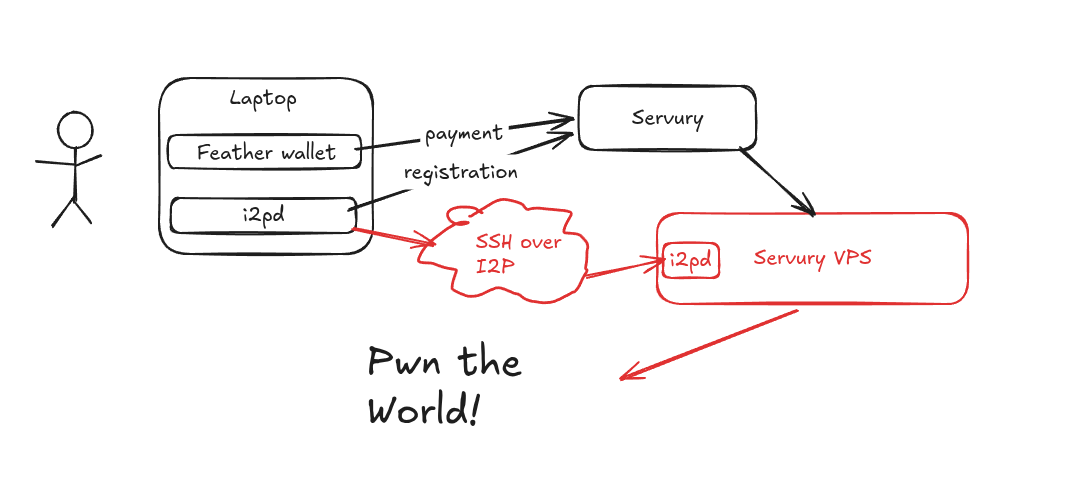
At every location you work, you should have a small server (it can be a Raspberry Pi) that has i2pd and Tor always on. On your laptop, you should turn on another i2pd anytime you are not on a metered connection. This creates a significant amount of decoy traffic, which minimizes the chances of a timestamp correlation.
Tor is still important for many things, since I2P doesn’t have good exit nodes (and it is not the idea of the network anyway). So I am not a hater, just an educated skeptic.
Monero
You’re going to spend some money here. Obviously, you don’t want to use fiat or traceable crypto. In my humble opinion, the only sane cryptocurrency that takes privacy seriously is Monero. So you will need a Monero wallet. I recommend Cake or Feather.
Optionally, and highly recommended, you can host your own Monero node! Since you already have a mini server with i2pd and Tor running constantly, you can spin it up and route onion and i2p addresses to your node. Then, list them on Monero.fail.
You get two extra benefits for plausible deniability:
- Others can use your node freely. You’re not its only user
- It is your trusted node now. You can use it for syncing (so you won’t be flagged anywhere when you open up your Cake wallet) and for sending transactions.
Buying and provisioning your VPS
The next step is to order your new VPS! I am not shilling anyone, but right now, the best service for that is Servury. It is so easy I almost believe it is a honeypot… They support native Monero payments, don’t require any registration, and have a native i2p web.
I won’t bloat this part of the article; you will find everything important on my Gist companion
How to use this
First and most apparent is the most private browsing you can get. Both clearnet and onion (you can spawn a Tor service on the VPS and use it too). SSH -D switch AKA poor man’s VPN, is easy to use, just not popular enough.
Just please make sure you don’t use the browser you typically use…
Another option is to install OpenCode on the VPS and do whatever you want from there. Reverse tunneling to your local model is very possible (part of the companion Gist). Needless to say, this is much better than using it just as a dumb proxy. The only traffic is kilobytes of text every minute, nothing to pair you to the VPS.
The Big Downside
There is one apparent downside worth talking about: the I2P network is quite small. In theory, if Feds controlled (not just listened to) the vast majority of nodes, they could trace you quite easily. But we are talking about 80%+ of nodes, which right now, in my opinion, is quite unrealistic. But maybe some of you have other information; if so, please let me know.
Anyway, the project is still small – this is how the website looked a year ago, before they vibecoded a nicer one. And the more people use it, the better it will be. So please, tell your friends about it and spread the word!